
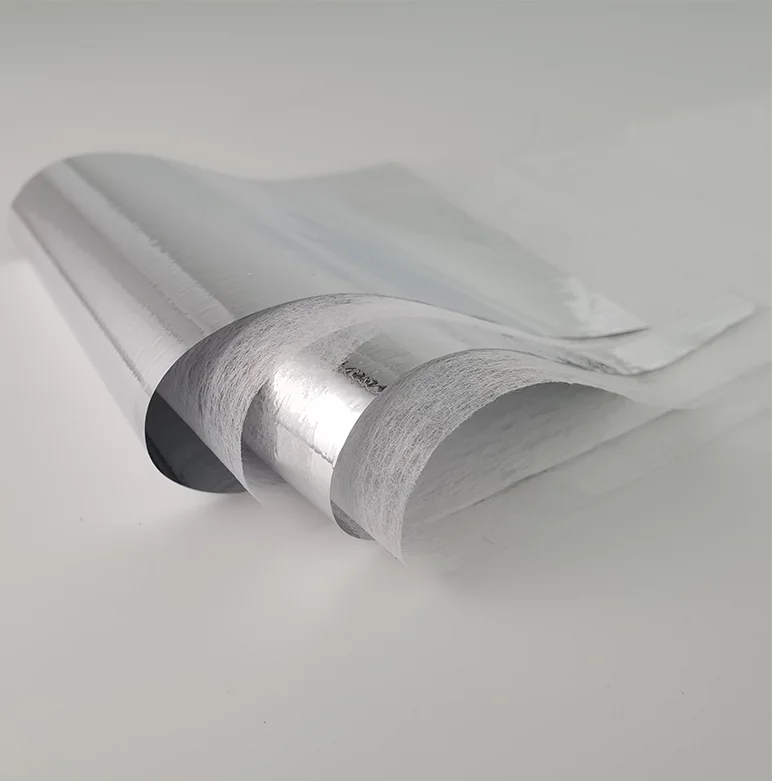
CryoMLI
CryoMLI 202
General cryogenic MLI for tanks, piping, cold boxes, superconducting cables, and research systems.
Typical applicationsCryogenic storage / Liquid hydrogen / Vacuum piping / Research cryogenics / +1 more
Engineering datasheet
Selection data and declared limitations
Technical sales will review the requested product and application conditions, then reply by email with document availability and next steps.

- Structure
- Double-sided aluminized PET + synthetic fiber paper
- Temperature range
- 4 K-393 K
- Recommended vacuum condition
- For a qualified evacuated insulation space. Final pressure, pump-down method, residual-gas load, hold time, and vacuum-maintenance strategy must be defined for the installed assembly; performance degrades as gas conduction increases.
- Thermal performance
- Apparent thermal conductivity and heat flux are installed-system values, not unconditional roll-material properties. No single value is published here. Request data for stated hot / cold boundary temperatures, vacuum level, layer density, seam design, and test method.
- Width and roll options
- Master-roll availability plus custom slitting and rewinding are confirmed by RFQ. Specify finished width, width tolerance, roll length, core, winding direction, and packaging limits.
- Layer configuration options
- Available as constituent reflector / spacer materials or as project-specific multilayer packages. Layer count and installed density are selected from boundary temperatures, vacuum, geometry, and target heat leak.
- Processing options
- Slitting and rewinding to confirmed dimensions
- Sewing and blanket assembly where the structure permits
- Drawing-based or sample-based cutting
- CNC vibration-knife profile cutting, openings, and project kit packaging
- Typical applications
- Notes and limitations
- Not a structural support, pressure boundary, seal, or substitute for vacuum-system design.
- Published temperature ranges describe constituent material capability; adhesive, seam, contamination, oxygen-service, and installation limits can narrow the usable range.
- System heat leak must be validated for the actual assembly and test conditions.
- Download PDF
Product technical table
CryoMLI 202 technical data
The table below is published as product-level reference data. Final use still depends on application geometry, vacuum condition, installation density, cleanliness, and customer validation.
| Item | Unit | Technical specification |
|---|---|---|
| Synthetic Fiber Paper basis weight | g/m² | 15 ±1 |
| Synthetic Fiber Paper thickness | mm | 0.08 ±0.01 |
| Synthetic Fiber Paper thermal conductivity | W/(m·K) | < 0.032 |
| Synthetic Fiber Paper moisture content | % | < 10 |
| Synthetic Fiber Paper loss on ignition | % | < 0.3 |
| Double-sided Aluminized PET (Mylar) basis weight | g/m² | 17 ±1 |
| Double-sided Aluminized PET (Mylar) thickness | mm | 0.012 |
| Double-sided Aluminized PET (Mylar) coating | Å | 600Å+600Å |
| Double-sided Aluminized PET (Mylar) emissivity | ε | 0.014 (@87K, NASA GRC) |
| Thermal shrinkage rate (180°C, 30min) | % | ≤ 3.0 |
| Spacer Gas Permeability | - | Moderate (fiber mat, moderate pump-down) |
| Comprehensive tensile strength | MPa | ≥ 190 |
| Apparent thermal conductivity | W/(m·K) | < 1.22×10 -4 |
| Leak outgassing rate | Pa·m³/(s·g) | < 2.8×10 -7 |
| Reference Heat Flux (40 layers, 78K-294K) | W/m² | ~0.7 (est., ref: NASA A126, DAM + paper) |
| Operating Vacuum Requirement | - | < 1×10 -4 Torr (high vacuum) for rated performance |
| Appearance | - | Smooth surface, free of impurities |
| Standard Widths | mm | 90 / 100 / 200 / 300 / 910 / 1310 / 1800 / 2000 |
| Maximum Production Width | mm | 2160 |
| Custom Width | - | Available (MOQ and surcharge apply) |
| Composite Layer Configurations | - | 5/5, 10/10, 20/20 (mature); custom available |
| Recommended Layer Density | layers/mm | 1.0 - 2.0 |
| Roll Material — Max Layers | - | Up to 10/10 |
| Shape Customization | - | Supported (vibration knife cutting) |
| Processing Capabilities | - | Rewinding, sewing, cutting, lamination |
| Production Method | - | Fully automated mechanical production |
| Application Temperature Range | - | 4K(-269°C) - 393K(120°C) |